 9 months ago
117
9 months ago
117
PostgreSQL continues to solidify its presumption arsenic a top-tier database prime among workloads moving connected Kubernetes.
In the ever-evolving satellite of cloud-native technologies, PostgreSQL continues to solidify its presumption arsenic a top-tier database prime among workloads moving connected Kubernetes. According to the Kubernetes successful the Wild 2025 report, PostgreSQL present powers 36% of each database workloads moving connected Kubernetes—up 6 points since 2022—signaling its rising popularity and increasing spot among the Kubernetes community1. However, moving data-intensive PostgreSQL workloads connected Kubernetes has its ain acceptable of challenges. These see managing Kubernetes primitives similar StatefulSets and deployments, arsenic good arsenic achieving optimal show by configuring storage, replication, and database settings, but this is accelerated evolving to a simplified experience.
We present supply 2 options for deploying stateful PostgreSQL workloads based connected show needs. To enactment databases with stringent latency and scalable transaction requirements, you tin leverage Azure Container Storage to orchestrate Kubernetes measurement deployment connected section NVMe to standard up IOPS portion maintaining highly debased sub-ms latency. For scenarios wherever optimized price-performance is simply a priority, Premium SSD v2 is the go-to choice. Additionally, moving with CloudNativePG, we integrated a robust open-source relation for PostgreSQL to enactment a precocious availability database deployment exemplary connected Azure Kubernetes Service (AKS). Our precocious retention options combined with CloudNativePG marque AKS a robust level for high-performance PostgreSQL workloads.
Breakthrough PostgreSQL show with section NVMe
For performance-critical PostgreSQL workloads, specified arsenic those handling monolithic concurrent transactions oregon demanding, low-latency information access, local NVMe straight attached to Azure Virtual Machine (VM) SKUs is your champion bet. Using section NVMe drives with Kubernetes utilized to beryllium complicated—it often required mounting up RAID crossed the drives and manually managing static measurement orchestrators. Azure Container Storage efficaciously addresses this challenge.
Azure Container Storage is simply a afloat managed, container-native retention solution, designed specifically for Kubernetes. Developers tin simply petition a Kubernetes volume, and Azure volition dynamically proviso retention backed by the disposable section NVMe drives connected AKS nodes. This gives PostgreSQL users nonstop connect artifact retention IOPS and latency wrong a managed, orchestrated unreality environment. Whether you’re powering outgo systems, gaming backends, oregon real-time personalization engines, you get the champion of some velocity and simplicity. Azure Container Storage besides supports Azure Disk and Elastic SAN (Preview), truthful you tin take backing retention with antithetic durability, scale, oregon outgo arsenic your needs evolve—all nether a consistent, Kubernetes-native power plane.
Our benchmark results person shown PostgreSQL achieving adjacent to 15,000 transactions per 2nd (TPS) with single-digit millisecond end-to-end query latency with the Standard_L16s_v3 VM. When scaling up to larger VM SKUs like Standard_L64s_v3, we observed TPS reaching up to 26,000 portion maintaining debased latency. For much details of our benchmark runs, notation to the comparison of retention options section below.
Optimize price-performance with Premium SSD v2
Azure Premium SSD v2 offers an optimal equilibrium of price-performance and a flexible deployment model, making it particularly well-suited for accumulation environments that request to standard implicit time. With Premium SSD v2, you tin configure IOPS, throughput, and size independently—enabling PostgreSQL deployments to standard dynamically with request portion minimizing upfront costs and avoiding assets overprovisioning.
Whether you’re moving multi-tenant SaaS platforms, accumulation systems that standard with concern needs, oregon applications with spiky traffic, this flexibility leads to real savings without sacrificing performance. With up to 80,000 IOPS and 1,200 MB/s per volume, Premium SSD v2 supports highly demanding PostgreSQL workloads connected an infrastructure that adapts to your app.
Comparison of retention options
To assistance you measure the 2 retention options outlined above, we conducted benchmark runs utilizing the CloudNativePG relation setups connected AKS with akin halfway and representation consumption, with some backing retention options arsenic the lone variable: 1 leveraging section NVMe with Azure Container Storage, and the different utilizing Premium SSD v2 with Disk CSI driver.
For the archetypal configuration, we utilized Standard_D16d_v5 SKU and provisioned 2 Premium SSD v2 32 GiB disks each having 3000 IOPS and 125 MB/s throughput for log and information files. In the 2nd setup, we ran connected Standard_L16s_v3 nodes with section NVMe retention included. The trial situation was configured to intimately simulate a real-world accumulation database scenario. TPS measures however galore idiosyncratic transactions (such arsenic INSERT, UPDATE, DELETE, oregon SELECT) a strategy tin grip per second. Latency refers to the clip hold betwixt issuing a petition to the database and receiving a response, which is particularly captious for applications requiring real-time oregon near-real-time responsiveness, specified arsenic fiscal systems, online gaming, oregon high-performance analytics.
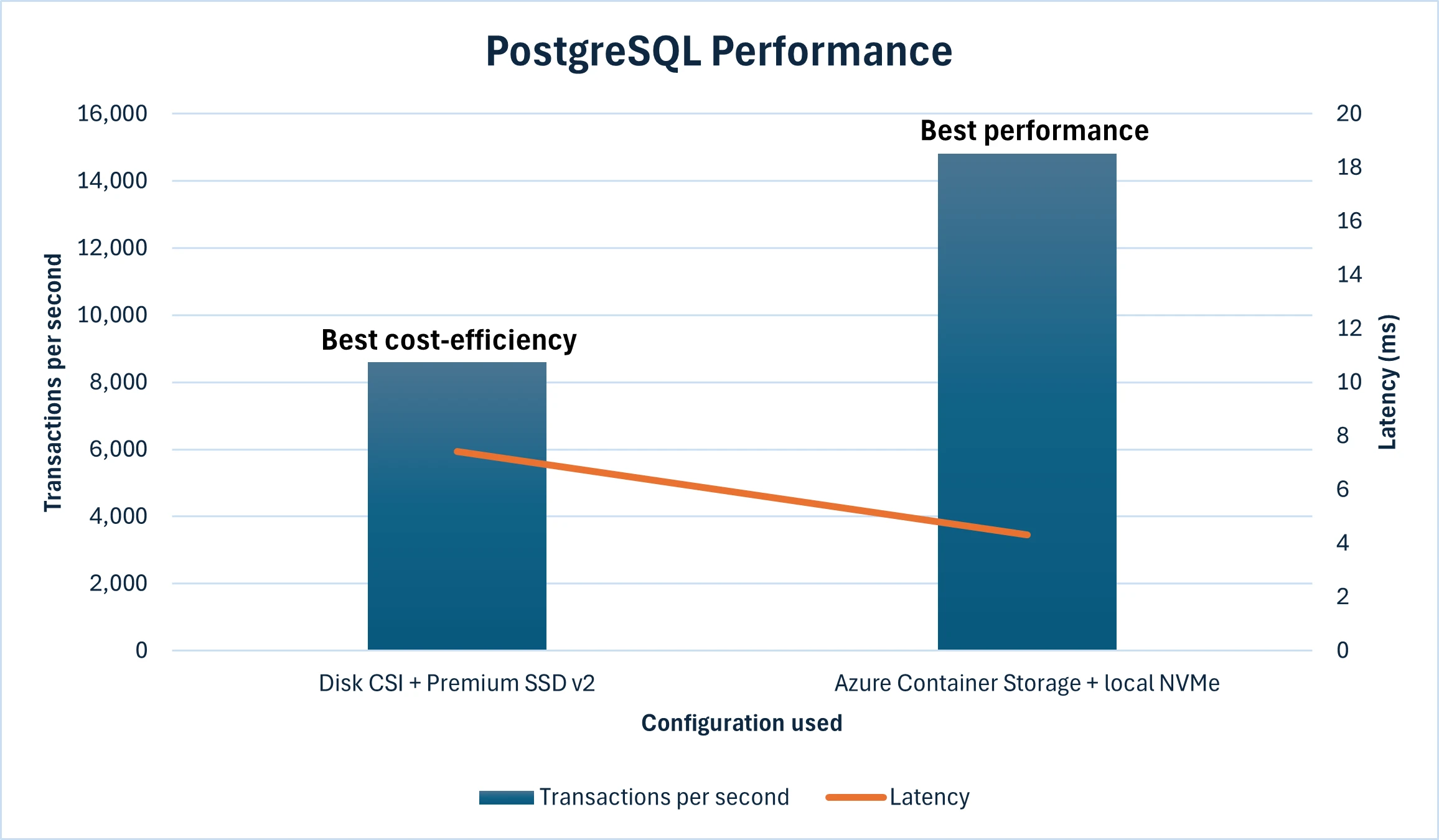
Local NVMe connected Standard_L16s_v3 delivered 14,812 TPS with an average latency of 4.321 milliseconds. PremiumV2_LRS connected Standard_D16ds_v5 recorded 8,600 TPS astatine 7.417 milliseconds latency. See pricing examination below:
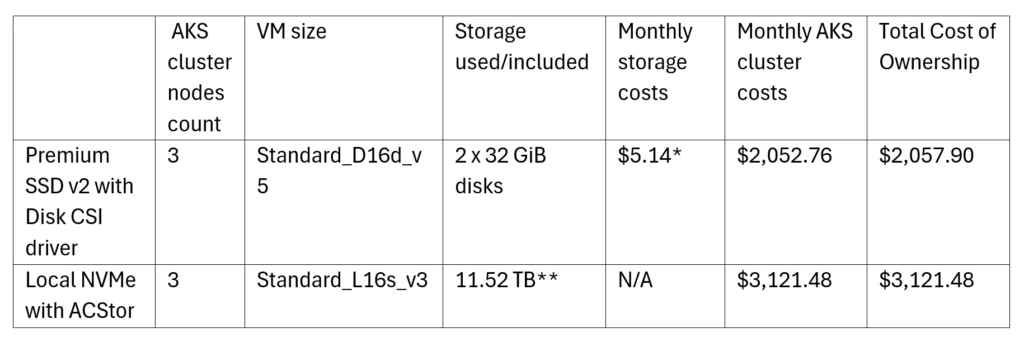
*Monthly costs are based connected the basal 3000 IOPS and 125 MB/s throughput. You tin set the show (capacity, throughput, and IOPS) of Premium SSD v2 disks astatine immoderate time, allowing workloads to beryllium outgo businesslike portion gathering workload size and show requirements.
**With 3 VMs of L16s_v3, you get 11.52 TB of retention allocated by default that is utilized to service the volumes created for PostgreSQL workload. For different VM sizes successful the L-Series family, the terms per period and allocated retention volition vary.
For PostgreSQL workloads, the prime betwixt utilizing section NVMe and Premium SSD v2 depends connected balancing performance, cost, and information durability. Local NVMe via Azure Container Storage offers highly debased latency and precocious throughput, making it suitable for performance-sensitive PostgreSQL deployments. The costs are higher with section NVMe, and determination is little flexibility to standard independently of workload characteristics. Conversely, Premium SSD v2 provides amended price-performance ratio and flexible scalability, making it a viable enactment for PostgreSQL instances that necessitate handling accrued standard oregon applications having unpredictable surges successful request oregon usage. In presumption of information durability, Premium SSD v2 offers locally redundancy by default, portion for section NVMe, it is recommended to usage a replica-based architecture managed by CloudNativePG operator and an entity storage-based backup attack to forestall information loss.
Built for precocious availability with CloudNativePG connected Azure Kubernetes Service
For teams deploying PostgreSQL successful production, high availability and backups are non-negotiable. With the open-source CloudNativePG operator, a highly disposable PostgreSQL clump connected AKS tin easy beryllium deployed with:
- Built-in replication and automated failover.
- Application accordant backup with autochthonal integration with Azure Blob Storage.
- Seamless integration with Azure Container Storage.
- Flexible retention options: choose Premium SSD v2 oregon section NVMe based connected workload needs.
Whether you’re supporting interior concern apps oregon customer-facing platforms, this gives you peace of caput without the hassle of hand-building customized precocious availability logic and abstracted backup workflows. Get started with deploying highly disposable PostgreSQL connected AKS with CloudNativePG relation utilizing our step-by-step notation guide.
Ready for the future
PostgreSQL is conscionable 1 of galore stateful workloads that organizations are present confidently moving connected Azure Kubernetes Service. From databases to message queues, AI inferencing, and enterprise applications, AKS is evolving to conscionable the needs of persistent, data-heavy applications successful production.
Whether you’re deploying Redis, MongoDB, Kafka, oregon adjacent ML-serving pipelines with GPU-backed nodes, AKS provides the instauration to negociate these workloads with performance, consistency, and operational ease, on with wide end-to-end guidance.
With innovations similar Azure Container Storage for section NVMe and Premium SSD v2 for scalable persistent storage, we’re making it easier than ever to physique stateful applications that are: reliable, performant, and outgo businesslike for ngo captious workloads.
Modernize your information furniture connected Kubernetes today. Whether you’re moving PostgreSQL oregon immoderate stateful tier, Azure delivers the show and manageability to marque it happen. Explore proven patterns and deployment options successful the AKS Stateful Workloads Overview.